

AI Account Agent vs. AI SDR: Which Fits Warm Outbound?
An AI SDR is built to run prospecting at volume: it researches leads, drafts messages, sequences follow-ups and books meetings. An AI account agent is built around the account you already care about: it watches one target account over time, warms its decision-makers, and hands the account to a rep when the buyer is ready. If your team is Seed to Series B, has a defined target account list and a CRM full of past conversations, the account agent is the stronger fit for warm outbound. Kynzo is the AI Account Agent for Warm Outbound, and the rest of this guide shows how to judge the difference for yourself.
Key Takeaways
- *Unit of work differs. An AI SDR works a list of leads through a sequence. An AI account agent works one account continuously, using signals from systems you already own.
- *Data source decides the outcome. Agents that read your CRM, warehouse, inbox and product usage act on context you trust. Agents fed scraped lists inherit the list's quality problems.
- *Cadence is a deliverability question. Burner domains and blasted follow-ups put your sending reputation at risk. A human cadence inside local business hours does not.
- *Handoff is the real finish line. Measure how fast a rep gets a ready account with context, not how many messages went out.
- *Mixed models work. Many teams run an SDR-style motion for the long tail and an account agent for the named accounts that drive revenue.
Table of Contents
- What an AI SDR does
- What an AI account agent does
- AI account agent vs. AI SDR, side by side
- Autonomy: copilot, autopilot, or both
- Data: why the source matters more than the model
- What the evidence says about AI in outbound
- Deliverability and trust: the quiet cost of volume
- When each approach fits a Seed to Series B team
- What the SDR role becomes
- The four stages of the Kynzo warm outbound engine
- A buyer's checklist for either approach
- Try the account agent on your own accounts
- FAQ
- Sources
What an AI SDR does
A sales development rep (SDR) is the person who finds prospects, starts conversations and qualifies interest before an account executive (AE) takes over. An AI SDR automates that job. IBM's overview of AI SDRs places the work across inbound qualification, outbound prospecting, lead nurturing, multichannel engagement, follow-up and handoff into the pipeline.
LeanData's guide, citing Gartner, describes an AI SDR as software that works autonomously through the early sales motion: profiling target accounts, writing personalized messages, sending and accepting LinkedIn requests, following multichannel sequences, asking qualifying questions and scheduling meetings. The same piece reports base agents at roughly $800 to $1,500 per month, with most deployments landing between $1,500 and $3,500 per Gartner.
The common thread is a funnel view. The input is a list of people. The output is meetings. The agent's success is judged by volume and conversion through the sequence.
That works well when the motion is clear and repeatable: a defined ideal customer profile, a large addressable market, and a message that holds up across many recipients.
What an AI account agent does
An AI account agent flips the unit of work. Instead of a list of leads, you give it a list of target accounts. It then keeps a standing watch on each one.
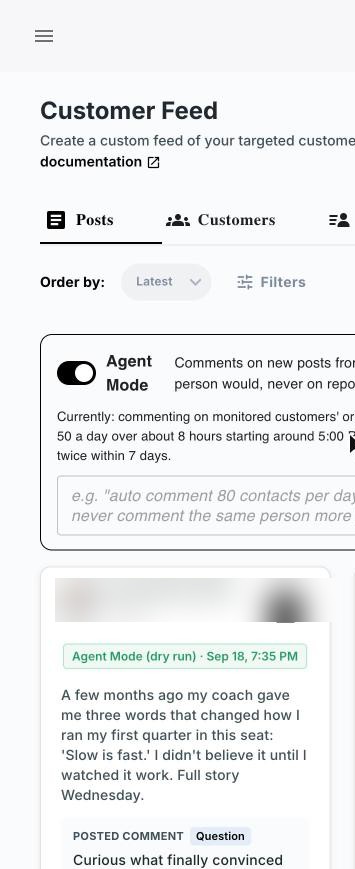
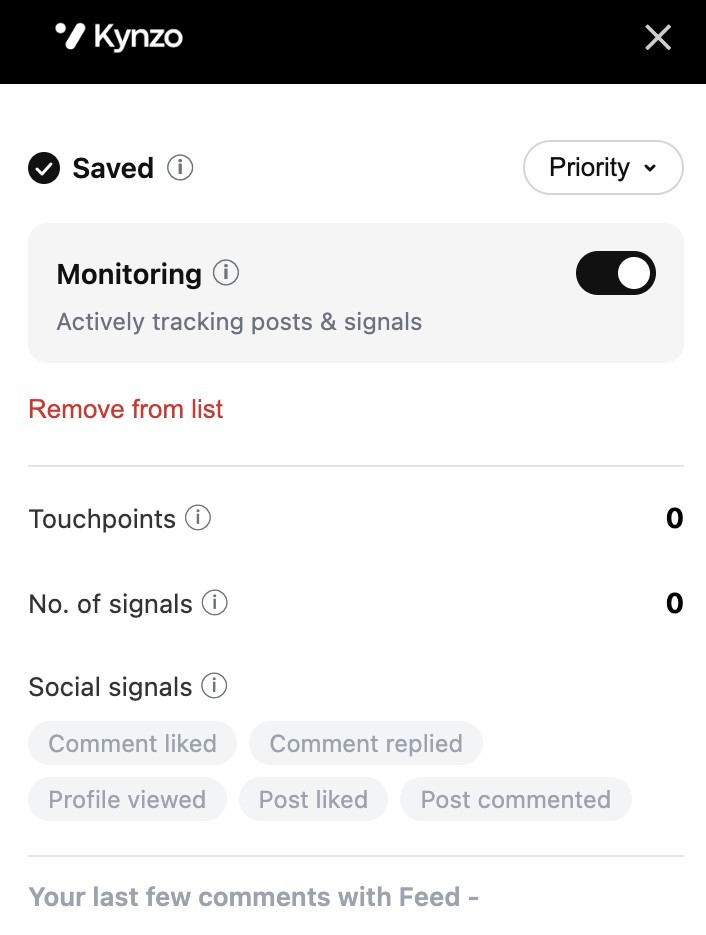
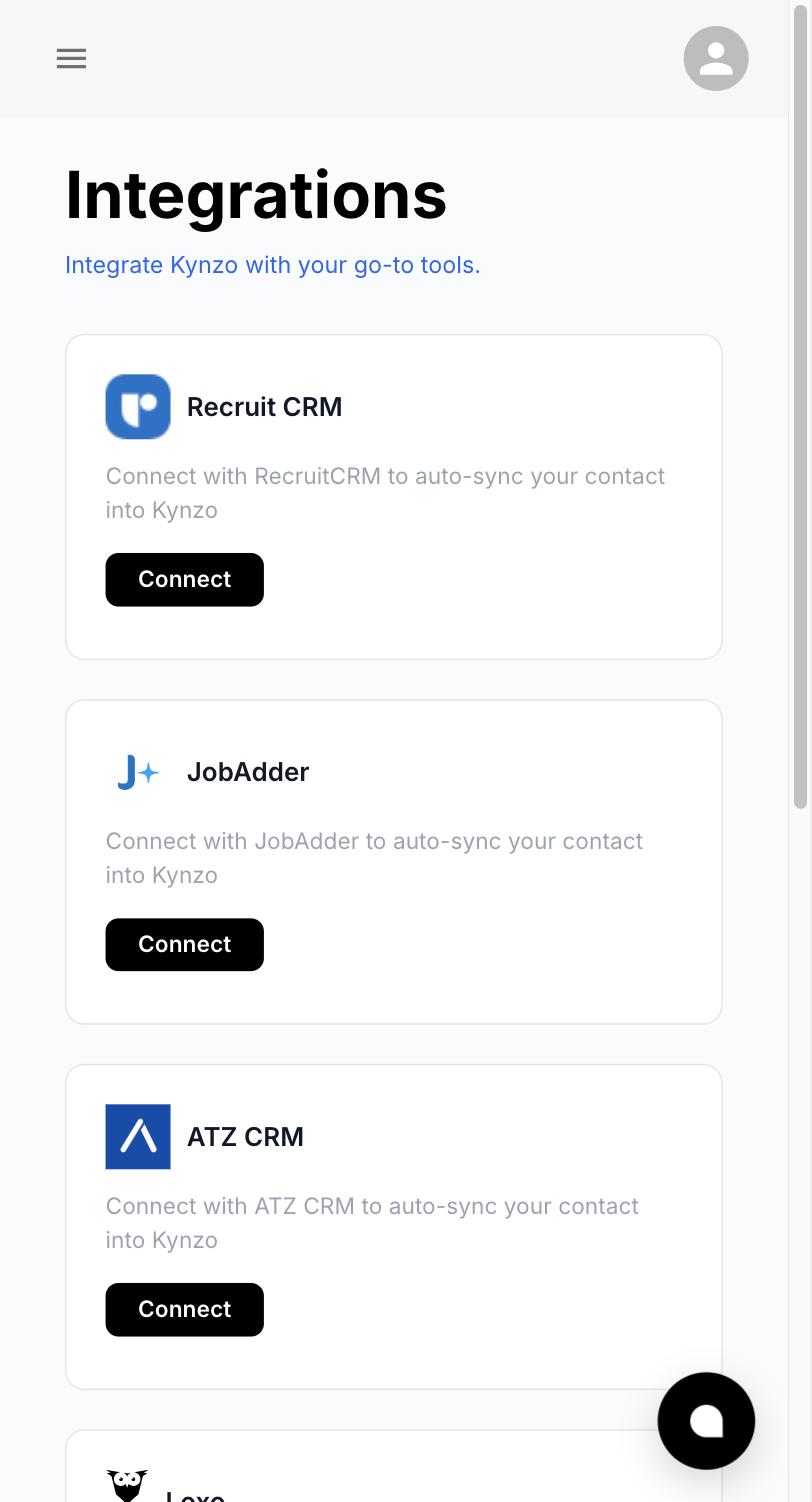
Kynzo's version works like this. It connects to your existing systems of record: your CRM, your data warehouse (Snowflake, BigQuery or Databricks), your email inbox, product usage and contact lists. It assigns a dedicated AI Account Agent to every target account. Each agent monitors live buyer signals, hiring triggers and strategic shifts around the clock, then warms decision-makers with peer-level perspective at a natural human cadence. When an account crosses 90° readiness, Kynzo writes the activity back to your CRM or data warehouse and alerts your team in Slack with the context needed to book the intro call.
Three things follow from that design:
- *The account has memory. Prior conversations, open opportunities and usage data inform each touch, so the agent never greets a customer's champion like a stranger.
- *Timing comes from the buyer. A job change, a hiring surge or a new strategic initiative triggers the touch. A calendar does not.
- *The agent's job ends at readiness. It exists to deliver a warm intro call to a human, not to run a sequence to exhaustion.
AI account agent vs. AI SDR, side by side
| Dimension | AI SDR | AI account agent (Kynzo) | |---|---|---| | Unit of work | Lead or contact list | One dedicated agent per target account | | Typical data source | Enrichment and lead databases, plus CRM | Your CRM, data warehouse, inbox, product usage and contact lists | | Trigger for outreach | Sequence step or list entry | Live buyer signals, hiring and job-change triggers, strategic shifts | | Messaging approach | Personalized message variants | A-A-O: Acknowledge, Add Perspective, Earn Familiarity, in an executive peer voice | | Cadence | Sequence timing | Local business hours, natural human jitter, daily caps | | Sending infrastructure | Often separate outbound domains | Zero burner domains required | | Autonomy | Copilot to autopilot, depending on product | Copilot and Autonomous AI Agent modes | | Finish line | Meeting booked | Account crosses 90° readiness, CRM writeback, Slack handoff with a ready-to-send warm opener |
The naming across the market overlaps, so a label alone tells you little. A product called an AI SDR can include signal tracking and a product called an agent can be a sequencer. Compare the specific job, the context the agent can read, its autonomy settings and its handoff. Those four attributes separate the approaches in practice.
Autonomy: copilot, autopilot, or both
Both categories span a range. In one mode a human approves each message. In the other the agent researches, writes, sends and replies on its own. GTM teams commonly pick by segment: more oversight on strategic accounts, more autonomy on the long tail.
Kynzo supports both ends. In Copilot mode your rep reviews and approves what the agent drafts. In Autonomous AI Agent mode the agent operates on its own inside the cadence rules you set: local business hours, natural human jitter and daily caps. A Seed or Series A team with two reps can run Autonomous mode on a broad target list and keep Copilot mode for the ten accounts that decide the quarter.
The practical question to ask of any tool is what happens with human approval and without it. Get that answer in writing for each mode before you commit.
Data: why the source matters more than the model

Both approaches are only as good as the records they act on. LeanData's survey of 109 GTM teams found that data quality degraded execution for 70% of teams . In the same survey, 27% had multiple tools or agents contacting the same prospect, 30% had agent actions on records with no clear audit trail, and 60% named agents acting on the wrong records as their top fear when scaling.
Those findings point to three design requirements for any agent you let near buyers:
- *Records you already trust. An agent reading your CRM and warehouse works from your own history. That is the Connect stage of Kynzo's engine: existing systems of record in place of scraped cold lists.
- *One agent per account. When a single agent owns an account, two tools do not collide on the same buyer.
- *An audit trail. Kynzo writes its activity back to your CRM or data warehouse, so every touch is visible where your team already works.
Freshness matters too. Airbyte's explainer on AI SDR agents notes that relevant context can include CRM ownership, pipeline and churn history, enrichment, prior touches and approved messaging, and that stale engagement or scheduling data can trigger inappropriate actions. The same piece argues for explainable qualification scores that show which CRM, engagement, support, billing or product-usage signals drove the score. A readiness score is useful only if a rep can see why it moved.
What the evidence says about AI in outbound
Independent, peer-reviewed comparisons are thin, and many figures in circulation are vendor claims. Treat each number below as a data point from its source's own test, not a guarantee for your team.
A November 2025 eight-week side-by-side study from Revenue Reimagined compared AI-assisted teams with human-only teams. AI-assisted teams booked 32.7 meetings per 1,000 prospects against 18. Positive reply rates were 6% against 3.21%. Time to first touch fell from 41.2 hours to 9, and cost per meeting dropped from $412.80 to $238.70.
The same study found that human-screened accounts converted at 1.4 times the rate of an AI-only list. The lesson for account selection is direct: a curated target account list beats a raw one. An account agent starts from exactly that curated list, because you choose the accounts and the agent monitors them.
Kynzo's own verified GTM benchmarks, measured against cold email, are:
- *3.8x reply lift versus cold email
- *+40% warm intro conversion
- *-34% sales cycle compression
- *0 burner domains required
These are Kynzo's figures for its warm outbound motion, and they describe what the system is designed to deliver when you point it at accounts with real signals.
Deliverability and trust: the quiet cost of volume
Outbound at volume has a cost that does not appear on the vendor's pricing page: sender reputation. Burner domains exist because volume sending damages the domain it runs on, and the workaround is to rotate domains until they burn. Founders who have rebuilt a sending setup know how much time that consumes.
A warm approach changes the arithmetic. Kynzo's agents run with zero burner domains and zero spam. They warm decision-makers at a human cadence, inside the local business hours of each account, with natural jitter in timing and daily caps on activity. Because the touches are paced like a person's, the motion avoids the pattern that gets domains flagged in the first place.
The human side matters as much as the technical one. A decision-maker who sees a peer-level observation about their own hiring plan or product launch reads it differently than a templated opener. That is the purpose of the A-A-O framework:
- *Acknowledge what the buyer is doing: a new initiative, a hire, a launch.
- *Add Perspective that an executive peer would offer, grounded in the account's context.
- *Earn Familiarity over repeated, well-spaced touches so the first call is not the first impression.
When each approach fits a Seed to Series B team
The right choice depends on your motion, not on the label.
*Choose an AI account agent when:
- You sell to a defined set of named accounts, and each deal is worth enough that one bad touch costs real money.
- Your CRM, warehouse and inbox already hold a useful history of conversations, product usage and past opportunities.
- You have a small sales team, and reps spend their week chasing signals across tabs instead of selling.
- Your sales cycle is long, and shortening it by warming the buying committee early is worth more than adding raw top-of-funnel volume.
*Lean on an SDR-style motion when:
- Your market is broad and the message is simple and repeatable.
- You need to fill the top of the funnel from lists you do not yet have in your CRM.
- The inbound side, where qualification questions are bounded, is the bigger lever.
*Combine both when: you run a long-tail segment and a named-account segment. Use volume tools on the first, and give the second to account agents so each strategic account gets a consistent, informed presence.
If you are choosing one first, start with the segment where a lost deal hurts most. For most Seed to Series B teams that is the named-account list, because every account there has a name, an owner and a history in your systems.
What the SDR role becomes
Agents do not remove the need for people. They change the work. The SDR who used to copy-paste sequences moves toward orchestration: choosing which accounts matter, configuring the agent, reviewing messages, handling replies and passing context to the AE. Karter McKinley's analysis of AI SDR role design describes that shift from repetitive execution to account judgment and contextual handoff.
In Kynzo's workflow that handoff is explicit. When an account crosses 90° readiness, the agent writes the activity back to your CRM or data warehouse and posts an alert in the #gtm-warm-handoffs Slack channel with a ready-to-send warm opener. The rep opens Slack, sees why the account is ready, and sends the opener. No dashboard to check and no manual research before the first call.
The four stages of the Kynzo warm outbound engine
Here is how the system runs, stage by stage, so you can compare it with whatever you are evaluating.

1. Connect
Kynzo links to your CRM, your data warehouse (Snowflake, BigQuery or Databricks), your email inbox, product usage and contact lists. Everything the agent knows comes from systems you already own.
2. Track
Each account's agent watches live buyer priorities, hiring and job-change triggers, and strategic initiatives. It does so around the clock, so a signal at 2 a.m. gets noticed before your team logs in.
3. Warm
Using A-A-O, the agent engages decision-makers in an executive peer voice. It operates inside local business hours with natural human jitter and daily caps, in Copilot or Autonomous AI Agent mode, with zero burner domains.
4. Hand off
Kynzo scores buyer readiness in real time. At 90° readiness it writes activity back to your CRM or data warehouse and sends the Slack warm handoff alert with the opener your rep needs.
One pattern to watch in your own build: for how the pieces tie together on the LinkedIn side, see Kynzo's guides to account-based LinkedIn outreach and LinkedIn buying signals .
A buyer's checklist for either approach
Use these questions in any vendor evaluation, including ours.
- *What is the agent's specific job? Prospecting, account warming, qualification or all three.
- *What can it read? CRM, warehouse, inbox, product usage. List them.
- *What triggers a touch? A signal, a schedule or a list position.
- *What are the autonomy modes? What happens with and without human approval.
- *How is sending infrastructure handled? Whether the setup needs extra domains.
- *Where does activity get logged? A visible CRM or warehouse record for every action.
- *What does handoff look like? Who is told, where, and with what context.
- *How is success measured? By segment and autonomy level, and tied to pipeline, not message counts.
A useful side effect: answering these questions forces you to write down your own motion. Many teams find that exercise sharpens their target account list before any tool goes live. For routines that pair well with an account-led motion, the guide on LinkedIn outreach cadence covers pacing in detail.
Try the account agent on your own accounts
Kynzo prices by plan, so you can match it to the size of your team:
- *Individual: $100 per month for 1 user and 10,000 accounts monitored.
- *Team: $250 per month for up to 50 users and 10,000 accounts per user.
- *Enterprise: custom pricing for unlimited users and accounts, with Snowflake, BigQuery and Databricks sync, SAML/SCIM/SSO and a dedicated forward-deployed engineer.
Every plan starts with a 14-day free trial, no credit card required. A founder running outbound alone can start on Individual. A scale-up with several AEs and SDRs can put the whole team on Team and share one view of every account. See the pricing page for plan details.
[

](https://apps.kynzo.io/Onboarding/CreateAccount)
If you want to see how the Slack handoff and CRM writeback look in practice, start the trial at kynzo.io , connect your CRM, pick ten target accounts and watch which ones cross 90° readiness first.
FAQ
Is an AI account agent just an AI SDR with a different name?
No. The difference is the unit of work and the trigger. An AI SDR typically runs leads through sequences. An AI account agent, like Kynzo's, is assigned to a single target account, reads your own systems of record and acts on live buyer signals. Because product labels overlap across the market, judge any tool by its job, data access, autonomy settings and handoff.
Will AI replace SDRs?
The role is changing more than disappearing. Repetitive research and follow-up move to agents, while people take on account selection, agent configuration, message review and replies. With Kynzo, the rep's job shifts to taking the warm intro call that the Slack alert delivers, with context already attached.
Do I need separate domains to run an AI account agent?
No. Kynzo requires zero burner domains. It warms decision-makers at a human cadence within local business hours, with natural jitter and daily caps, and logs the activity back to your CRM or data warehouse.
How much does Kynzo cost, and can I try it first?
Individual is $100 per month for 1 user and 10,000 accounts monitored. Team is $250 per month for up to 50 users, with 10,000 accounts per user. Enterprise is custom. All plans begin with a 14-day free trial, and no credit card is required.
How should I measure an AI account agent?
Track results by segment and autonomy mode: reply rate, warm intro conversion and sales cycle length against your cold email baseline. Kynzo's benchmarks are a 3.8x reply lift, +40% warm intro conversion and -34% sales cycle compression, so those are the numbers to compare against.
Sources
- IBM: Beyond Automation, How AI SDRs are Redefining Sales
- LeanData: AI SDRs at Enterprise Scale
- Airbyte: AI SDR Agents, How They Automate Sales Development
- Revenue Reimagined: AI Prospecting vs Human Intuition
- Karter McKinley: AI SDR, Redesigning Sales Roles