

Warming a buying committee means earning familiarity with every person who can approve, shape or block your deal before anyone asks for a meeting. For Seed to Series B teams, the most reliable way to do it is to keep one dedicated agent on each target account, fed by your own CRM, inbox and product data, so the champion, the economic buyer and the technical evaluator each hear from you at a human pace. That is the job of Kynzo, the AI Account Agent for Warm Outbound: it connects to your systems of record and warms decision-makers with peer-level perspective, instead of sending cold sequences from burner domains.
Key Takeaways
- Committees are large and often in conflict: Gartner reports buying groups of up to 16 people, and 74% show unhealthy conflict during the decision.
- Content built for the group's shared problem lifts consensus by 20%. Content tailored to each individual's view hurts it by 59%.
- Map roles first, then warm in order: champion, decision-maker, then influencers and blockers.
- Measure the buying group, not the lead: count roles reached inside each account.
- Kynzo assigns an AI Account Agent to every target account and alerts your team in Slack when an account crosses 90° readiness.
Table of Contents
- Why one warm contact is not enough
- Who sits on a B2B SaaS buying committee
- Step 1: Map the committee from your own data
- Step 2: Read the signals that say a role is ready
- Step 3: Warm with one shared story, not eight pitches
- Step 4: Hand off at the right moment
- Step 5: Measure the group, not the lead
- What Kynzo costs and how to start
- FAQ
- Sources
Why one warm contact is not enough
A single enthusiastic champion feels like progress. It is not a committee. Gartner's 2024 survey of 632 B2B buyers found that 74% of buying teams show unhealthy conflict during the decision, and groups that reach consensus are 2.5 times more likely to call the deal high-quality . Gartner also notes buying groups now run to as many as 16 people across four functions, each with its own priorities.

Size estimates vary by study and by what the study counted. A comparison of published figures runs from 4.8 people in TrustRadius's January 2025 survey of 2,058 buyers to 13 internal stakeholders plus 9 external influencers in Forrester's January 2026 research. The practical reading for a scale-up: a mid-market deal with finance, IT and a line-of-business owner already has a committee, and the larger the deal, the more roles join late.
Two consequences matter for your outbound:
- Most members cannot approve a purchase, but nearly any of them can stall one. RevenueFlow describes this veto asymmetry : technical and security evaluators can disqualify but seldom select, and procurement and legal enter late and often reopen settled terms.
- Buyers do their thinking without you. Zumo Marketing, citing Gartner, reports that buyers spend 17% of their time with vendors and 83% on independent research and internal conversations . Familiarity has to be built before the formal process starts.
Who sits on a B2B SaaS buying committee
Rework's guide lists seven roles in software deals. Here is how each shows up for a tech scale-up selling to a company with 200 to 5,000 employees.
| Role | What they care about | Where deals stall | |---|---|---| | Champion | Solving a visible problem for their team | Cannot sell internally without proof | | Economic buyer | Return on spend against other uses of budget | Never meets you before the final stage | | IT / architecture | Integration, SSO, SCIM, admin load | Enters late with new requirements | | Security / CISO / DPO | Compliance, data handling | Can add weeks of review | | Legal / procurement | Contract terms, price | Reopens settled terms | | End users | Daily workflow | Quiet resistance after rollout | | Executive sponsor | Strategic fit | Has no context on the problem |
Rework notes that security stakeholders may appear in week four of a five-week deal and introduce requirements that take six more weeks to resolve . Warming those roles early is what keeps that surprise from landing at the end.
Step 1: Map the committee from your own data
Start with what you already hold. Your CRM contacts, email threads, product usage and past opportunities show who has already engaged. A usable map has, per open account:
- Role (champion, economic buyer, technical, legal or procurement, user)
- Name and LinkedIn profile
- Engagement level on a 1 to 5 scale
- Last conversation date
One mapping template suggests that 4 to 6 actively engaged stakeholders is the target, with fewer than three being a single point of failure. Two deal-review questions keep it honest: who is the champion and how recently did we speak, and who is the economic buyer and have we met them?
Where it goes wrong: committees are usually informal, so the map is an inference. Treat every role as a hypothesis until a conversation confirms it, and refresh it when a hiring or job-change event shifts who owns the problem.
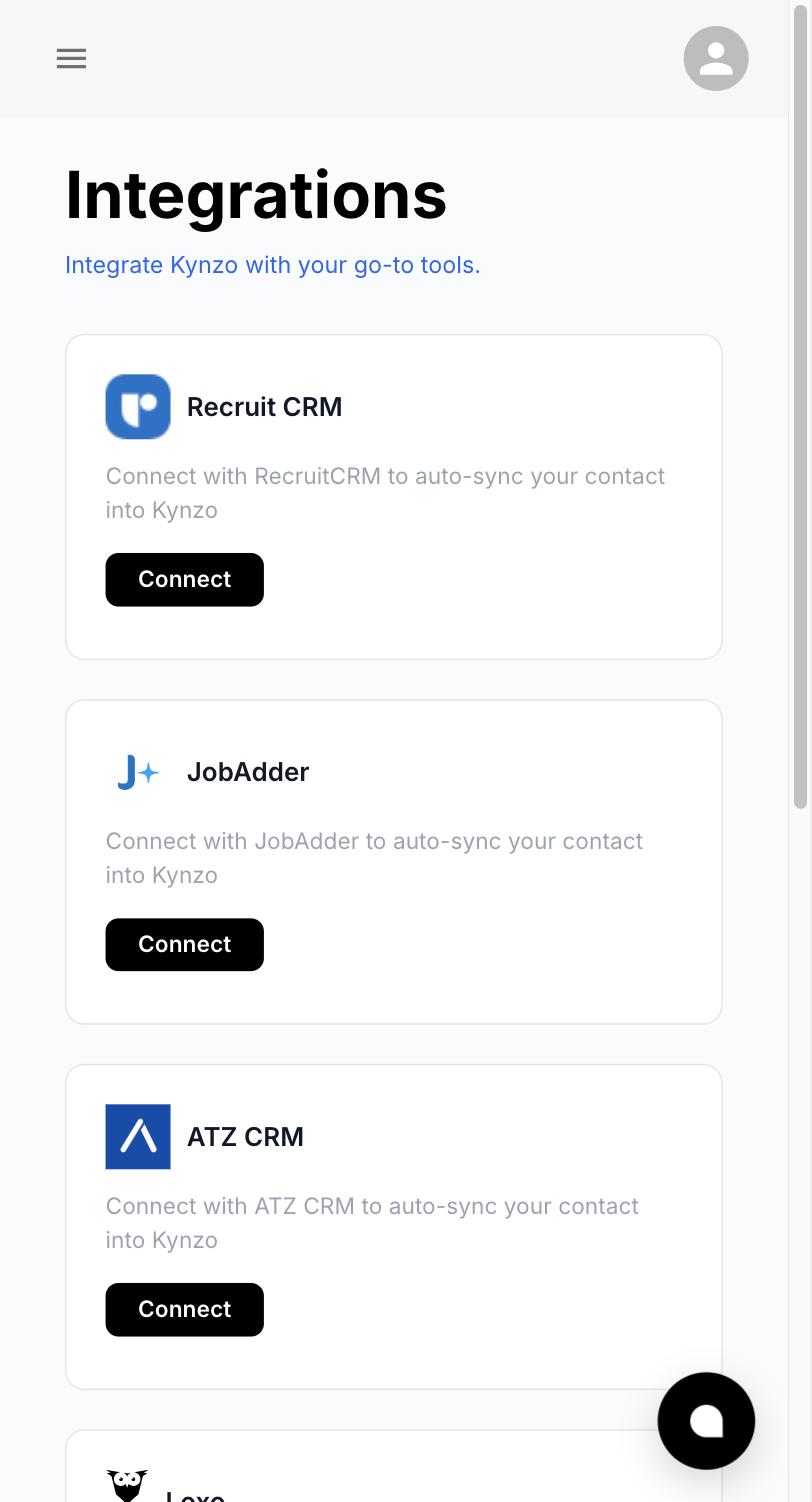
This is the first stage of Kynzo's workflow. It connects to your CRM, data warehouse (Snowflake, BigQuery or Databricks), email inbox, product usage and contact lists, so each target account's agent starts from your relationships instead of a scraped cold list.
Step 2: Read the signals that say a role is ready
Timing decides whether a message feels relevant or intrusive. The signals worth watching at account level:
- *Hiring and job changes. A new VP in the function you serve, or a cluster of roles opening in the team that owns the problem.
- *Strategic shifts. Funding, a new product line, a reorganization or a stated priority from an executive.
- *Buying team changes. TechTarget's buyer-behavior report finds 6 in 10 buying teams changed shape in the past two years , with 31% adding business stakeholders and 28% adding technical ones. A new face on the account is a signal in itself.
- *Product usage and inbox activity. A second user from a different department logging in, or a forwarded email, tells you the committee is widening.
Account-level beats lead-level here. GrowthSpree's 2026 analysis reports 2.1 to 2.8 times higher win rates on $50K+ ACV deals for account-level orchestration, with a timing rule of champion first, decision-maker second, influencers and blockers later. Treat those as one vendor's analysis, and use the sequencing rule as your starting order.
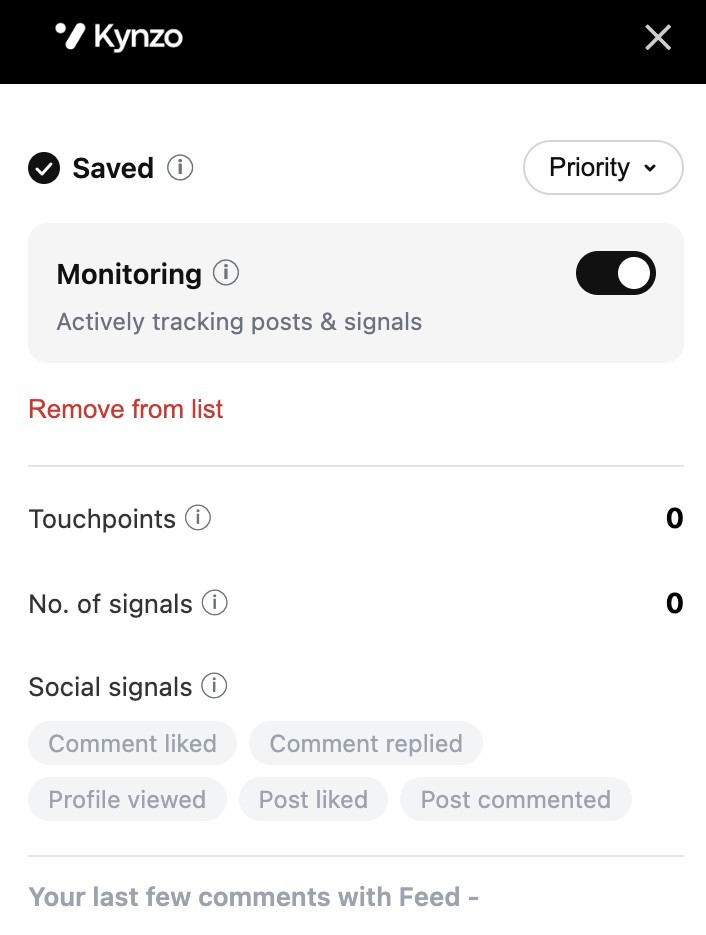
Kynzo's agents track live buyer signals, hiring triggers and strategic shifts around the clock, and score buyer readiness in real time, so a rep is not refreshing a dashboard to find the moment.
Step 3: Warm with one shared story, not eight pitches
This is where most committee outreach breaks. The intuition is to personalize hard for each persona. Gartner's data says otherwise: content tailored for buying-group relevance improves consensus by 20%, while content tailored to individual perspectives has a 59% negative impact . Each person should hear the same underlying point of view about the shared problem, framed at their altitude.
The A-A-O framework keeps that discipline:
- *Acknowledge. Reference something real: a post, a launch, a hiring push, a stated priority.
- *Add perspective. Offer one peer-level observation that is useful whether or not they ever buy.
- *Earn familiarity. Stop there. Let the relationship build through repeated, relevant, low-pressure presence.
A worked example. You sell revenue-forecasting software to a Series C fintech. The new VP of Sales posts about a rebuilt pipeline-review process. A cold email says "saw your post, can we talk?" An A-A-O touch acknowledges the rebuild, adds a short observation on why forecast accuracy drifts when reviews depend on rep-entered stages, and asks for nothing. The same week, the RevOps lead receives the same observation framed around data quality. The VP of Finance sees it framed around variance against plan. Same story, three altitudes, no pitch.
Warm introductions work for a similar reason. A message arriving from someone the buyer already trusts transfers trust from the connector rather than the seller. Familiarity built through peer-level touches is how you become that kind of known name before the intro request. For a view on what to automate and what to keep human in this kind of outreach, the judgment calls sit at the edges: who to approach, when to stop and what to say to an executive.
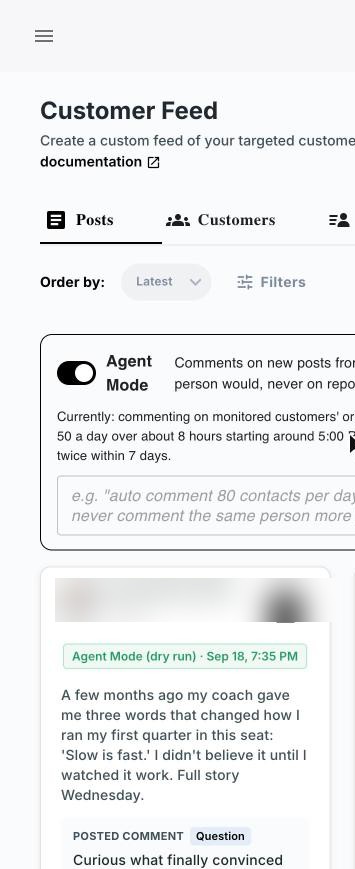
Kynzo writes in an executive peer voice using A-A-O, and runs in Copilot mode, where your team reviews the touch, or Autonomous Agent mode. It operates inside local business hours with natural human jitter and daily caps, with zero burner domains and zero spam.
Step 4: Hand off at the right moment
Warming ends when the account is ready for a conversation, not when a sequence runs out. Define readiness before you start: at least two roles engaged, the champion active in the last two weeks, and an economic buyer who recognizes your name.
In Kynzo, that threshold is 90° readiness. When an account crosses it, the agent writes the activity back to your CRM or data warehouse and sends a Slack alert to #gtm-warm-handoffs with a ready-to-send warm opener. The AE gets the context of every touch and the book-the-intro-call move in one message, so the first live conversation starts warm.

Step 5: Measure the group, not the lead
If your dashboard credits one contact's activity score, it will call a single-threaded deal healthy. TechTarget argues demand teams should make the buying group the unit of measurement : track which roles have entered the conversation and redefine "engaged" as multiple roles reached inside an account. For a deeper look at measuring engagement across a whole account , the same logic applies to content as to outreach.
Metrics to track per cohort of target accounts:
| Metric | What it tells you | |---|---| | Roles reached per account | Threading depth | | Time from first touch to second role engaged | Speed of committee coverage | | Warm-intro conversion rate | Quality of warming | | Reply rate on warm touches vs. cold | Channel efficiency | | Sales cycle length, warmed vs. unwarmed | Downstream impact |
One caution on benchmarks: the comparison of published studies shows win rates peaking around 29% with three buying groups and falling to about 12% at six , and warns that high touch counts reflect deals that progress, not a target to chase. Depth beats volume.
For reference, Kynzo's own GTM benchmarks are a 3.8x reply lift over cold email, +40% warm intro conversion, a 34% shorter sales cycle and zero burner domains required. Compare them with your own baseline once a cohort has run.
What Kynzo costs and how to start
Kynzo is built for the way a scale-up sells: your existing systems in, a dedicated agent per account, and warm handoffs out.
- *Individual: $100 per month for 1 user and 10,000 accounts monitored.
- *Team: $250 per month for up to 50 users, with 10,000 accounts per user.
- *Enterprise: custom pricing for unlimited users and accounts, with Snowflake, BigQuery and Databricks sync, SAML/SCIM/SSO and a dedicated forward-deployed engineer.
There is a 14-day free trial with no credit card required. See Kynzo pricing to pick a plan.
[

](https://apps.kynzo.io/Onboarding/CreateAccount)
If you want the broader method behind this, the warm outbound sales playbook walks through the full motion.
FAQ
How many people are on a B2B buying committee?
It depends on the study and the purchase. Published estimates run from 4.8 to 13 internal stakeholders, and Gartner reports groups of up to 16 across four functions. Use the figure whose deal size and category match yours, and map real names rather than relying on an average.
Who should I warm first?
Start with the champion, then the decision-maker, then influencers and blockers, following the sequencing rule in GrowthSpree's analysis . Bring technical and security roles in early enough that their requirements do not arrive in the final weeks.
Should I personalize messages for every committee member?
Personalize the framing, not the story. Gartner's data shows content tailored to the group's shared problem lifts consensus, while content tailored to individual views hurts it. Keep one point of view and adjust the altitude per role.
How do I know an account is ready for a sales call?
Set a readiness rule in advance: multiple roles engaged, an active champion and recent signals. Kynzo scores readiness in real time and alerts your team in Slack when an account crosses 90°, with a ready-to-send warm opener.
Sources
- CSOs must foster alignment among buying teams, International Journal of Sales Transformation
- Buyer personas B2B, Zumo Marketing
- Buying Committee glossary, RevenueFlow
- B2B Buying Group Statistics: 4.8 to 17 People, Explained
- B2B SaaS Buying Committee: 7 Roles in the Room, Rework
- B2B Buying Committee Mapping Guide and Template
- How B2B Buyers Find, Evaluate and Choose Technology Today, TechTarget
- Account-Level Intent vs Lead-Level Intent, GrowthSpree
- How to Use Warm Introductions in Enterprise Sales, LetsBridge
- AI Sales Automation: What to Automate and What to Keep Human
- Top Content Engagement Strategies for Business Growth