

Signal-Based Outbound Strategy: A Playbook for B2B SaaS
A signal-based outbound strategy replaces "who fits our ICP?" with "which ICP accounts are showing a reason to talk right now?" You monitor a short list of live triggers on accounts you already care about, score them, and reach out only when the evidence stacks up, in a way that references what is actually happening at the account. For a seed to Series B team with a small sales bench, that is the difference between spending cycles on strangers and spending them on accounts that are already moving. Kynzo is built around this model: we assign an AI Account Agent to every target account, connect it to your CRM, warehouse and inbox, and hand your team a ready-to-send warm opener when an account crosses 90° readiness.
Key Takeaways
- Signal-based outbound starts from timing, not from a list. You pick accounts first, then let live triggers decide when and how to reach out.
- Stack signals from different categories (a hiring trigger plus a leadership change, for example) and filter every trigger against your ICP before anyone acts on it.
- Detection is the easy part. Teams fail at routing and at the first message, so define an owner, a response window and a message structure before you buy any data.
- Warming a buyer before the ask, with a peer-level comment or insight, protects your domain and lifts replies. Kynzo's benchmarks: 3.8x reply lift vs. cold email, +40% warm intro conversion, and -34% sales cycle compression.
- Start with one ICP segment, three signals and one handoff channel. Expand only after you can see which trigger types convert.
Table of Contents
- What signal-based outbound is, and how it differs from traditional outbound
- Which signals are worth tracking
- How to score and prioritize signals
- Build the workflow: from trigger to handoff
- Timing and personalization without sounding intrusive
- Common mistakes and how to avoid them
- How to measure whether it works
- Run it with Kynzo
- A 30-day rollout plan for a small team
- FAQ
- Sources
What signal-based outbound is, and how it differs from traditional outbound
Traditional outbound is list-driven. Someone builds a list of titles at companies of the right size, loads it into a sequence, and every contact gets the same cadence on the same schedule. The question driving it is "who should we contact?"
Signal-based outbound flips the question to "who is showing intent right now?" That reframe, which Factors.ai describes in its own workflow guide, changes what reps do all day: less list building, more responding to evidence.
Three practical differences matter for a startup sales team:
| | Traditional outbound | Signal-based outbound | |---|---|---| | Starting point | A static list of contacts | A defined set of target accounts plus live triggers | | Timing | Whenever the sequence fires | When a trigger or a stack of triggers appears | | Message | Generic value proposition | Anchored to the specific event or priority | | Volume | High, uniform | Lower, concentrated on accounts in motion | | Feedback | Open and reply rates | Conversion by signal type |
Note what signal-based does not mean. It does not mean buying a feed of intent alerts and emailing everyone who appears in it. A signal tells you when to look at an account. It does not tell you whether the account is a fit or what to say.
Which signals are worth tracking
Not every signal deserves a reaction. A useful way to rank them is by how close they sit to a real buying decision. One public-data signal framework groups them into three tiers:
- *Tier 1, direct pain. Hiring for the exact role your product replaces or supports, or a buyer publicly describing the problem you solve. Budget and acknowledged pain are both implied.
- *Tier 2, strategic change. Funding rounds, leadership changes, product launches, new market entries. These create a window where priorities get reset.
- *Tier 3, behavioral. Website visits, content downloads, ad clicks. Easy to collect, but the weakest on their own.
The same framework treats job postings as the most reliable public signal and says two overlapping signals from different categories point to active buying behavior. That second point is the one to build on: *stacking beats volume.
For a B2B SaaS team selling to other tech companies, a practical starter set looks like this:
- *A new VP, CRO or head of function in your buyer's org. New leaders audit tools and processes in their first months.
- *Hiring in the function your product serves. A cluster of SDR or RevOps openings tells you where the account is investing.
- *A funding round or public strategic initiative. Often the trigger for budget and urgency.
- *Champion job changes. A past user or champion who lands at a new target account is a warm door.
- *Your own first-party activity. Product usage, pricing page visits, replies in your inbox and past CRM history.
- *Buyer activity on LinkedIn. What a decision-maker posts and comments on is a direct read on current priorities. We cover this in more detail in our guide to LinkedIn buying signals .
The first-party and CRM signals are the ones most outbound tools ignore, and they are often the strongest. An account where a former champion now works, or where three people have used your free tier, is not a cold account. It is a warm account that nobody has noticed.
How to score and prioritize signals
A scoring model gives the team one answer to "which account is next?" You do not need a data science project. You need weights that reflect how much each trigger tells you about timing and fit.
A simple pattern:
- *Fit gate first. If the account fails firmographic criteria (size, segment, stack, geography), no signal gets it into the queue.
- *Signal weight. Give direct-pain and strategic signals more points than behavioral ones.
- *Breadth across the buying group. Signals from two or three different people at the account count for more than five from one.
- *Freshness. Decay points over time. A job change from last week matters more than one from last quarter.
The point of the fit gate is to avoid the most common failure: acting on a single signal without checking it against your ICP. Intent data is noisy by nature, so treat it as one weight in the score, never as the qualifier.
Kynzo's agents score buyer readiness in real time on a 0 to 90° scale, combining the signals they monitor on each account. When an account crosses 90°, the agent writes the activity back to your CRM or data warehouse and alerts your team, so the threshold is a decision your team has agreed on in advance, not a gut call in a Monday pipeline meeting.
Build the workflow: from trigger to handoff
A repeatable signal-based outbound workflow has four jobs. This is how we frame Kynzo's 4-stage warm outbound engine, and it works as a checklist even if you build parts of it yourself.
Stage 1: Connect your own systems first
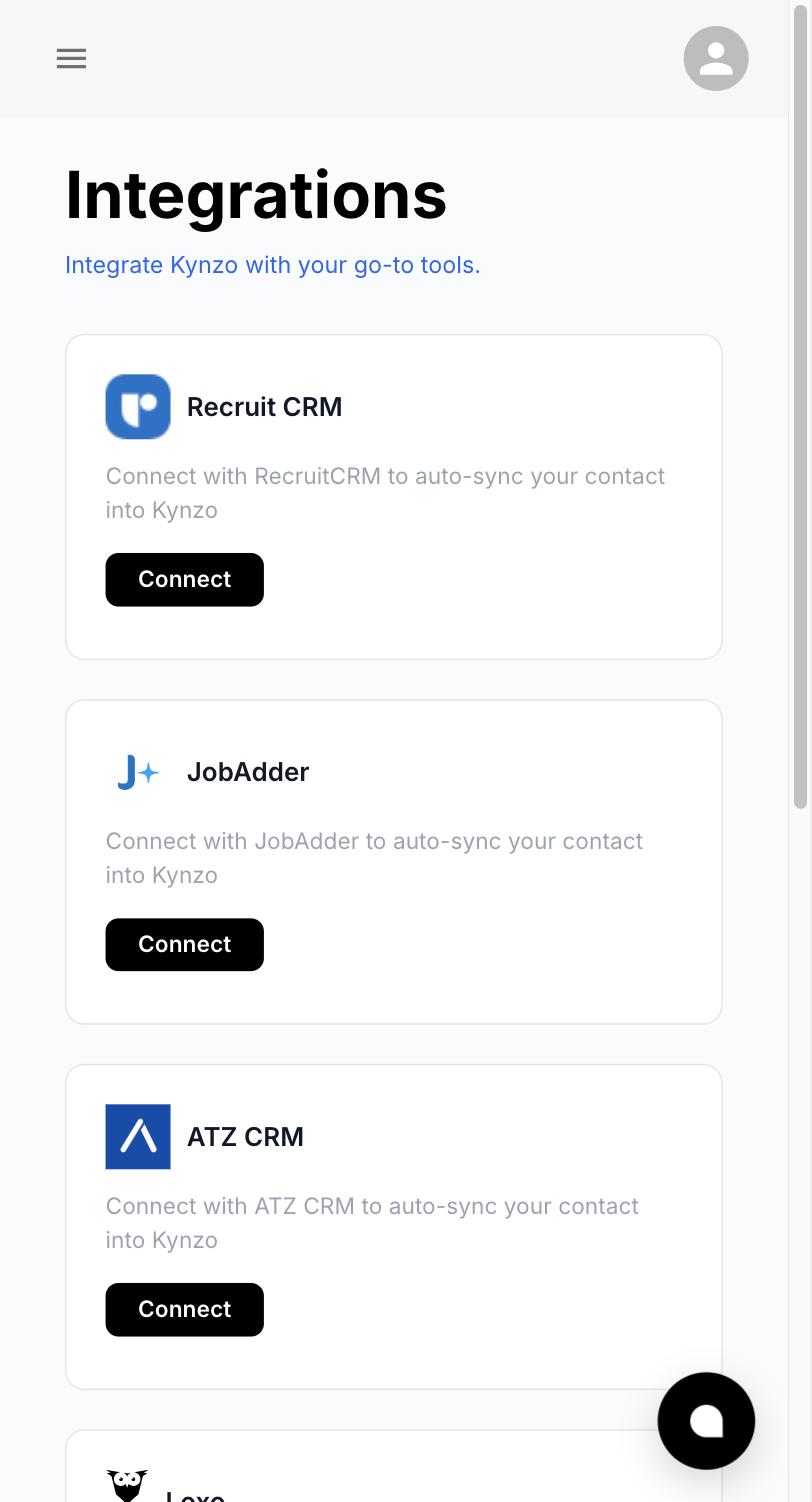
The best signal sources are the ones you already own: your CRM, your data warehouse (Snowflake, BigQuery or Databricks), your email inbox, product usage and contact lists. Starting here means your outreach is built on relationships and history rather than scraped lists.

Where it goes wrong: teams bolt on three third-party data vendors and never join the results to CRM records, so reps see an alert with no context on who already talked to whom. Kynzo connects to those systems of record directly, so each account agent sees the history alongside the live signals.
Stage 2: Track priorities, triggers and initiatives
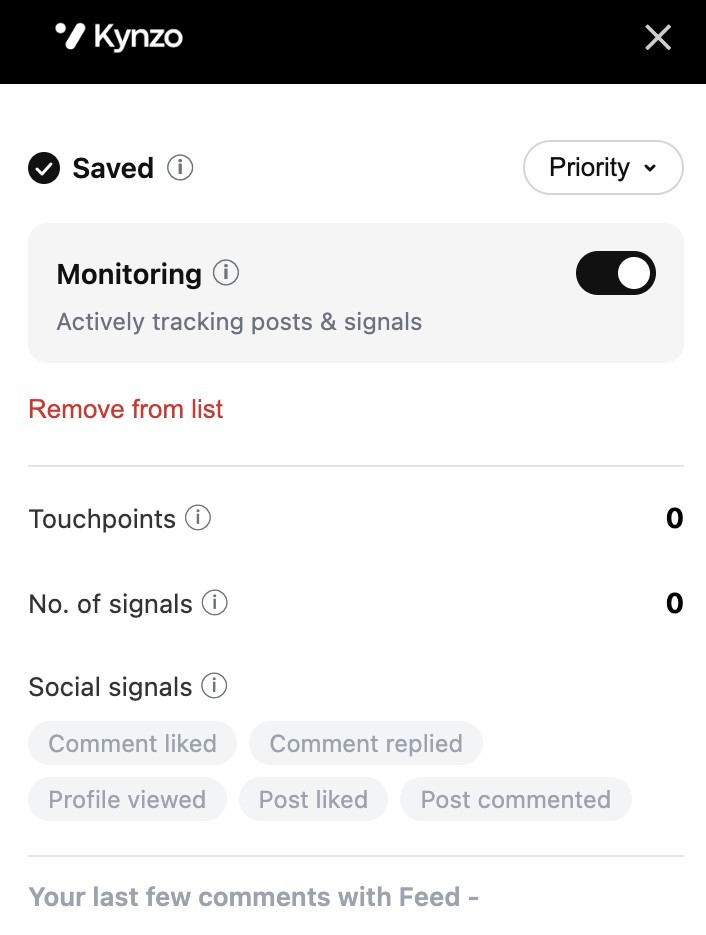
For each target account, monitor the triggers you chose: hiring, job changes, strategic initiatives and buyer priorities. Doing this by hand across 50 accounts is a part-time job. Across 500 it is not realistic.
Where it goes wrong: the weekly manual export. Signals have a shelf life, and a trigger that sits in a spreadsheet for a week loses much of its value. Kynzo's agents monitor each assigned account around the clock, so the signal is seen when it happens.
Stage 3: Warm the decision-maker before you ask
This is the stage most signal-based programs skip. They detect a trigger and immediately fire a cold email that says "saw you raised a round." The buyer has seen that email a dozen times.
We use the A-A-O framework instead:
- *Acknowledge. Respond to something the person actually said or did, such as a post, a comment or a stated priority.
- *Add perspective. Contribute a peer-level observation, not a pitch. An executive talking to an executive.
- *Earn familiarity. Repeat that presence at a natural cadence until your name is known before the intro request arrives.
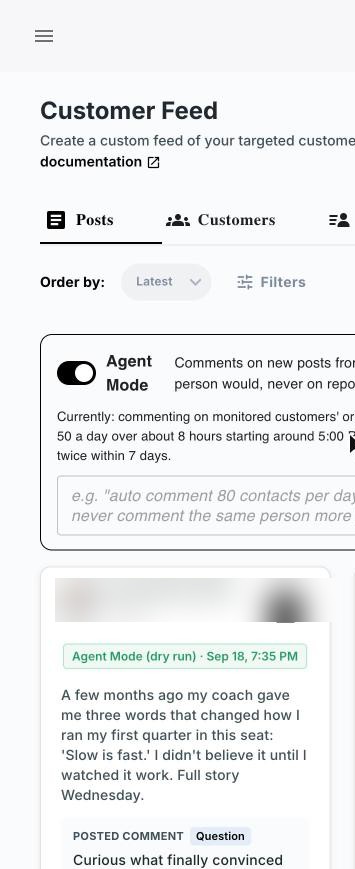
Kynzo's agents run this inside local business hours, with natural human jitter in timing and daily caps, so activity looks like a person working, not a bot. You can run them in Copilot mode, where your reps review and approve, or in Autonomous Agent mode. There are zero burner domains and zero spam. Kynzo's benchmark is that no burner domains are required.
For cadence design, see our notes on LinkedIn outreach cadence .
Stage 4: Hand off at the right moment
When an account crosses 90° readiness, the activity is written back to the CRM or warehouse and the team gets an instant Slack alert in #gtm-warm-handoffs with a ready-to-send warm opener. The rep arrives at the conversation with the trigger, the history and the draft message.
This is where signal programs live or die. Detection without fast, routed execution does little. Name an owner for each account, agree a response window (same business day is a sensible floor for a warm handoff), and log which trigger fired so you can learn from it.
Timing and personalization without sounding intrusive
A signal is permission to start a conversation, not permission to pretend you know the buyer. Three rules keep outreach from feeling like surveillance:
- *Reference public professional activity only. A post, a role change, a company announcement. Never reference anything that implies you tracked their browsing.
- *Lead with their priority, not your product. "Congrats on the new role" is generic. A short observation on a problem that role usually inherits is useful.
- *Let familiarity do the work. A comment on their post three days before an intro request lands very differently from a cold message from a stranger.
On timing, speed matters for the strongest signals (a direct hand-raise, a champion job change) and matters less for slower strategic signals. A reasonable pattern is same day for first-party behavior and replies, within a couple of business days for third-party events such as funding or a hire. Whatever you pick, write it down and measure it.
A worked example. Your ICP is Series B fintech companies. An account posts three SDR openings, then its new CRO comments on a post about outbound efficiency.
- *Signals stacked: hiring in your function (Tier 1) and a leadership change (Tier 2), from two different categories.
- *Wrong move: an email the same afternoon with a feature list.
- *Right move: an informed comment on the CRO's post that adds one concrete observation about ramping new SDRs, repeated over a week or two, then an intro request referencing that thread.
Our warm outbound sales playbook walks through more sequences like this.
Common mistakes and how to avoid them
- *Acting on one signal. Require a fit check plus at least one corroborating trigger before an account becomes a priority.
- *Missing the window. Automate enrollment so a trigger leads to action within a day or two, not at the next weekly review.
- *Generic messages after a real trigger. The trigger earns you the right to be specific. Use it.
- *Treating intent data as a qualifier. Intent feeds produce false positives, especially when matching is based on IP addresses. Use them as one score input.
- *No feedback loop. If your CRM does not record which trigger fired, you cannot tell which signals produce meetings. Write the trigger back on every account.
- *Rebuilding the signal layer by hand. Data plumbing needs constant maintenance as sources and APIs change. Decide early whether your team should own that work or hand it to an agent.
How to measure whether it works
Measure the program against your own cold baseline, not against figures from a blog. Track four things:
- *Reply rate by signal type. Which triggers actually start conversations?
- *Warm intro conversion. Of the accounts handed off at threshold, how many book a meeting?
- *Sales cycle length. Compare deals that began with a warm handoff against deals that began cold.
- *Speed from signal to first touch. If this number is long, fix routing before you add more signals.
For reference, Kynzo's own benchmarks across GTM teams are a 3.8x reply lift over cold email, +40% warm intro conversion and -34% sales cycle compression. Use them as targets to test against your segment, then let your own data set the bar.
Run it with Kynzo
If you want this workflow running without adding headcount, Kynzo assigns an AI Account Agent to each target account, connects to your CRM, warehouse and inbox, warms decision-makers at a human cadence and alerts #gtm-warm-handoffs the moment an account hits 90°. Every plan starts with a 14-day free trial, no credit card required.
- *Individual: $100/month for 1 user and 10,000 accounts monitored.
- *Team: $250/month for up to 50 users, with 10,000 accounts per user.
- *Enterprise: custom pricing for unlimited users and accounts, Snowflake, BigQuery and Databricks sync, SAML/SCIM/SSO and a dedicated forward-deployed engineer.
See the Kynzo plans and pricing to pick the one that fits your team.
[

](https://apps.kynzo.io/Onboarding/CreateAccount)
Comparing approaches first? Our pages on Kynzo vs Unify , Kynzo vs Swan and Kynzo vs AiSDR show how a full-loop account agent differs from signal routers and cold email AI SDRs.
A 30-day rollout plan for a small team
You do not need to launch everything at once. A seed to Series B team can get to a working program in a month:
- *Week 1: Pick one ICP segment and 100 to 300 target accounts. Choose three signals: one hiring trigger, one leadership change and one first-party signal. Connect your CRM and inbox.
- *Week 2: Set the fit gate and the readiness threshold. Agree who owns handoffs and the response window. Run the agents in Copilot mode so reps approve each message.
- *Week 3: Review what the agents surfaced. Cut signals that produced noise. Tighten the A-A-O messaging until reps would send it under their own names.
- *Week 4: Compare reply rate and meetings booked against your cold baseline for the same segment. Move proven account groups to autonomous mode and add a second segment.
FAQ
Is signal-based outbound the same as intent data?
No. Intent data is one category of signal, usually third-party and behavioral. Signal-based outbound is the whole strategy: choosing target accounts, tracking triggers from several sources including your CRM and product usage, scoring them, and acting with a tailored message. Intent data can be one input.
How many signals should I track?
Start with three to five that map to your ICP and your product's value. Include at least two categories, such as hiring and leadership change, so you can stack them. Add more only when you can show which triggers convert.
Does signal-based outbound work with a small sales team?
Yes, and small teams benefit most because it concentrates effort on accounts in motion. The constraint is monitoring and warming at scale, which is the work an AI Account Agent takes off your reps while they handle the conversations.
How fast should we respond to a signal?
Response speed should match signal strength. Hand-raises and replies deserve same-day action. Strategic events like funding or a new hire can wait a day or two, provided the owner and the window are defined in advance.
Sources
- Public Data Signals That Reveal B2B Buying Intent
- Signal-based Outbound Workflows: how GTM engineers trigger outreach with buyer intent