

C Suite or VP? Executive Search on LinkedIn for Buyers and Candidates
For high-stakes C-suite hires, retained search firms remain the most thorough path to a qualified slate, while mid-level executive roles often move faster through boutique headhunters or well-run LinkedIn job postings. Job seekers chasing recruiter attention should pair a sharpened LinkedIn profile with targeted engagement, not just inbound hope. The sections below break down each route, the fee and timeline shape you should expect, and the specific moves that get candidates noticed.
***
*TL;DR:
>
- Retained searches take several months; boutiques often deliver slates in weeks to a couple of months, while in house hiring can take weeks.
- Before signing, request documented time to slate, retention figures, and references from comparable searches; broad reputation claims do not show fit for your role.
- Recruiters assess career narratives, measurable accomplishments, and corroborating recommendations; a clear headline, summary focused on outcomes, and supporting media offer evidence beyond job titles.
- Thoughtful comments on hiring manager or target company posts can warm up contact before outreach, while LinkedIn guidance says cold InMail draws lower response rates.
- LinkedIn does not publish a fixed Recruiter seat price, while Kynzo lists its STARTER, PRO, and ELITE subscriptions at $12.90, $30, and $50 monthly.
***
Table of Contents
- Comparing Your Options: Retained Firms, Boutiques, In-House, and LinkedIn Tools
- How Recruiters and Executive Search Firms Actually Use LinkedIn
- How to Get Noticed by Executive Recruiters on LinkedIn
- A Framework for Choosing Between Search Routes
- LinkedIn's Growing Role in Executive Search
- Kynzo: LinkedIn Engagement Tools Built for Agency Recruiters
- FAQ
- Sources
Comparing Your Options: Retained Firms, Boutiques, In-House, and LinkedIn Tools
Four distinct routes dominate executive hiring today, and each uses LinkedIn differently.
- *Retained search firms run deep, research-heavy processes for board, CEO and C-suite mandates, using LinkedIn mainly for secondary research and candidate verification rather than primary sourcing.
- *Boutique or independent headhunters specialize in a sector or function and lean on LinkedIn for direct sourcing, warm outreach and tracking candidate movement.
- *In-house talent teams and LinkedIn job postings work well for roles below the C-suite, where speed and cost control matter more than exhaustive market mapping.
- *LinkedIn engagement platforms and recruiter tools support both firm types and in-house teams by surfacing hiring-manager activity and streamlining outreach timing.
Independent 2026 rankings suggest buyers should match a firm's documented strengths to the role in front of them, since a firm built for technology C-suite searches is not necessarily the right fit for board succession work. That same ranking data points to placement authority, retention figures and time-to-slate as the trust signals worth requesting before signing anything.
| Route | Best for | How LinkedIn is used | Typical fee shape | Typical timeline to slate | |---|---|---|---|---| | Retained search firm | C-suite, board, CEO succession | Secondary research, verification | Percentage of first-year compensation, paid in retainer installments | Several months | | Boutique or independent headhunter | Niche sector or functional leadership roles | Direct sourcing, outreach, network tracking | Contingency or reduced retainer | Weeks to a couple of months | | In-house team / LinkedIn job postings | VP and director-level roles, cost-sensitive searches | Job ads, Recruiter seat sourcing | Internal salary cost plus platform subscription | Weeks | | LinkedIn engagement platforms | Supporting any of the above with warmer outreach | Monitoring activity, in-feed engagement, CRM sync | Monthly SaaS subscription | Ongoing, not a one-time search |
Firms named across industry rankings, including Heidrick & Struggles, Korn Ferry, Scion Executive Search, JMJ Phillip Group, Bell Oaks Executive Search, Oxeon, Movement Search & Delivery, Direct Recruiters Inc., The Newport Group, and Search Solution Group, illustrate how wide this spectrum runs, from large retained practices to specialized boutiques built around a single industry vertical.
How Recruiters and Executive Search Firms Actually Use LinkedIn
Recruiters rarely treat LinkedIn as a single-purpose tool. Sourcing starts with Boolean strings built around title variants, industry keywords and tenure filters, letting a search consultant pull a market map in hours rather than days. From there, profile research becomes the filter: recruiters look for a clear career narrative, measurable accomplishments, and recommendations that corroborate the story rather than restate the job title.
In-feed engagement plays a growing role here. Commenting thoughtfully on a hiring manager's post, or on content shared by a target company, builds a warm signal long before any direct message gets sent. That stands in contrast to cold InMail, which LinkedIn's own career guidance notes tends to get lower response rates than engagement built on visible, consistent activity.
- Boolean and advanced search filters narrow a candidate pool before any outreach begins.
- Recommendations and endorsements act as informal reference checks during early screening.
- In-feed comments and shares often precede a direct message by days or weeks.
- Retained firms frequently supplement LinkedIn data with proprietary networks and off-platform research for sensitive C-suite searches.
*Pro Tip: *Comment on a hiring manager's post with a specific, substantive observation before ever sending a connection request. It reads as professional interest, not a sales pitch.
How to Get Noticed by Executive Recruiters on LinkedIn
Getting on a recruiter's radar is less about luck and more about a handful of deliberate moves, repeated consistently.
- *Rewrite your headline to state your function and scope, not just your job title, so it reads clearly in a search result snippet.
- *Reframe your summary around outcomes and scale, using specific accomplishments rather than generic responsibility statements.
- *Add supporting media, such as a talk, a press mention or a board bio, to give recruiters evidence beyond your own description.
- *Connect selectively with people in your target sector, including recruiters, rather than mass-connecting with strangers.
- *Comment regularly on posts from executives, recruiters and companies in your target space, favoring substance over generic praise.
- *Publish occasionally on topics tied to your expertise, since consistent, relevant posting surfaces your name in recruiter searches more reliably than a single viral post.
- *Respond quickly and specifically when a recruiter reaches out, referencing the role and asking a pointed question rather than sending a one-line acceptance.
LinkedIn's career content backs the engagement-first approach, noting that targeted interaction and a strong career narrative do more to attract recruiter attention than passive profile optimization alone.
*Pro Tip: *Treat your first reply to a recruiter message as a mini writing sample. Clear, specific answers signal the communication skills recruiters are quietly screening for.

A Framework for Choosing Between Search Routes
Match the route to the role before you match it to a brand name. A board-level or CEO search calls for a retained firm with documented placement and retention data; a functional VP hire often moves faster and cheaper through a boutique or in-house process.
- *Seniority and risk determine whether you need exhaustive market mapping or a faster, narrower search.
- *Speed requirements point toward boutique firms or in-house recruiting for roles where weeks, not months, matter.
- *Budget constraints should be weighed against the cost of a failed hire, not just the retainer size.
- *Process transparency matters: ask how candidates are sourced, screened and presented, and how often.
At the vendor interview stage, ask for documented time-to-slate figures, retention data and references from comparable searches rather than general reputation claims. Industry rankings suggest these published metrics, not marketing language, are the most reliable trust signal available to buyers.
| Decision factor | What to ask | Why it matters | |---|---|---| | Role seniority | What search depth does this role require? | Determines retained vs. contingency fit | | Documented outcomes | Can you share time-to-slate or retention data? | Separates evidence from marketing claims | | Process fit | How is LinkedIn used in your search process? | Reveals sourcing depth and research rigor |
LinkedIn's Growing Role in Executive Search
Executive search demand has expanded across private equity, healthcare, financial services and technology, with Hunt Scanlon's 2026 rankings reporting double-digit growth among many firms. That growth has not replaced judgment-led search. Hunt Scanlon's own reporting on major retained engagements, including public sector and university leadership searches, shows firms still lean on research-heavy, relationship-driven process for the highest-stakes roles. LinkedIn sharpens sourcing and timing, but it works best as an input to that judgment, not a substitute for it.
*— Jenny
Kynzo: LinkedIn Engagement Tools Built for Agency Recruiters
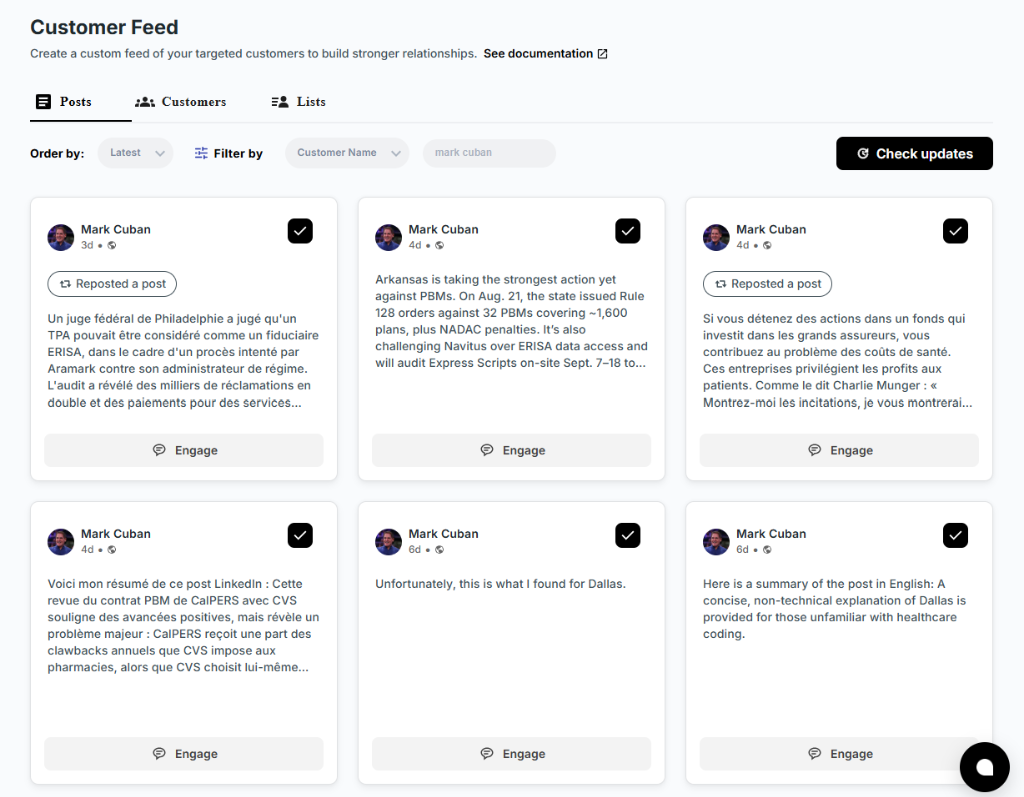
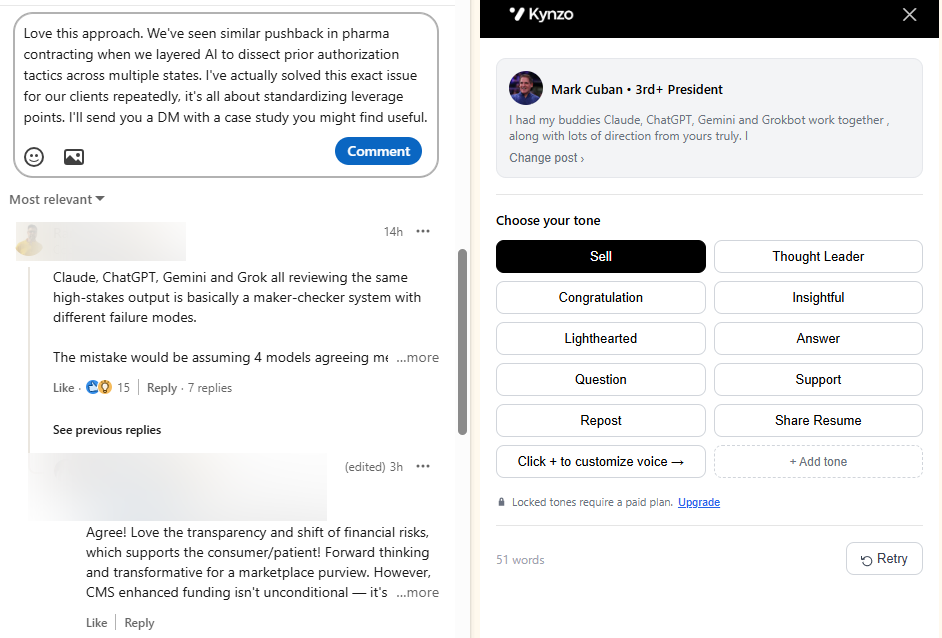
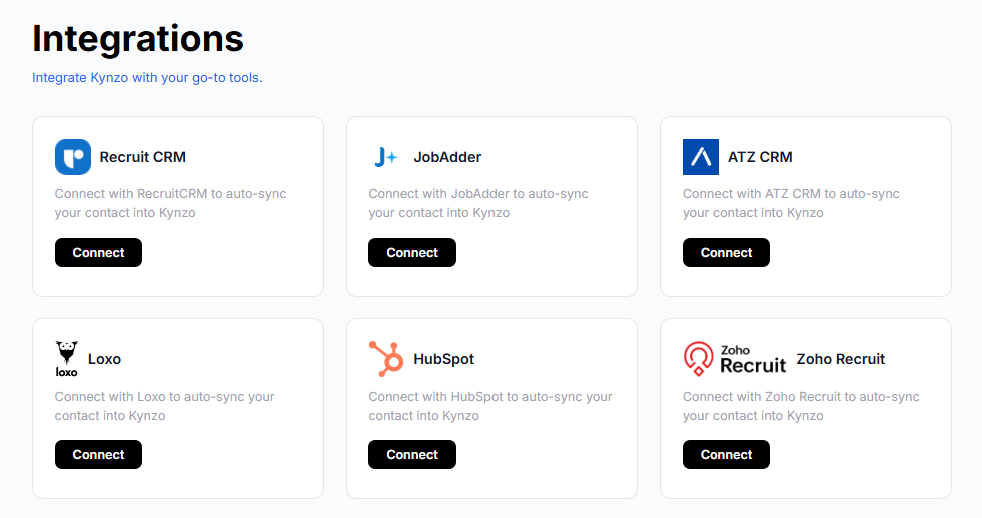
Recruiters and search consultants running the boutique and in-house routes described above tend to spend real time just watching LinkedIn for the right moment to reach out. We built Kynzo to take that waiting out of the process. We offer a Chrome extension and dedicated Customer Feed that track posts and activity from target hiring managers and company accounts separately from LinkedIn's general feed, so you see what matters without the scroll. The platform can synchronize target accounts with recruiting and CRM systems such as Recruit CRM, JobAdder, Zoho Recruit, HubSpot, Crelate and Loxo, and includes an AI Agent that drafts or publishes context-aware comments in the user's own voice, with pacing controls to keep activity looking human rather than automated.

- Track engagement signals like replies, comment likes, profile views and connection accepts to know exactly when to start outreach.
- Comment in your own voice at scale without the spam risk that comes with mass messaging or cold InMail.
- Sync automatically with your existing recruiting CRM instead of managing a separate spreadsheet.
If you want to test the approach before committing, try our free LinkedIn Comment Generator or explore the full STARTER, PRO and ELITE plans to see which fits your desk.
FAQ
Who are the big 5 executive search firms?
Industry rankings commonly cite firms such as Heidrick & Struggles and Korn Ferry alongside specialized players like Oxeon and Scion Executive Search, though exact rankings vary by source and methodology. Buyers should match a firm's documented strengths, such as sector focus or placement data, to their specific role rather than relying on brand size alone.
How do I find executive recruiters on LinkedIn?
Search by title and sector keywords, then check for consistent posting activity and client testimonials on a recruiter's profile. Engaging thoughtfully with their posts before connecting tends to work better than a cold connection request, according to LinkedIn's own career guidance.
Is executive search a good career?
Executive search offers strong earning potential and intellectual variety, and demand has grown across sectors including private equity, healthcare and technology according to Hunt Scanlon's 2026 report. It suits people who enjoy relationship-building and research more than high-volume transactional recruiting.
How much does LinkedIn Recruiter cost?
LinkedIn does not publish a single fixed price for Recruiter seats, and the published guidance treats this as information available on request through LinkedIn's own sales channels. For recruiters looking to extend LinkedIn activity with engagement tracking and CRM sync instead, Kynzo's STARTER, PRO and ELITE plans are listed at $12.90, $30 and $50 per month respectively.
What should I check before choosing an executive search provider?
Ask for documented time-to-slate and retention figures rather than general marketing claims, since independent industry rankings point to these as the most credible trust signals. Request references from searches comparable to your role in seniority and sector.
Sources
- Hunt Scanlon 2026 executive search rankings/report
- Top 5 Executive Search Firms in 2026 (Ranked) - KORE1
- How to get noticed by executive recruiters — LinkedIn